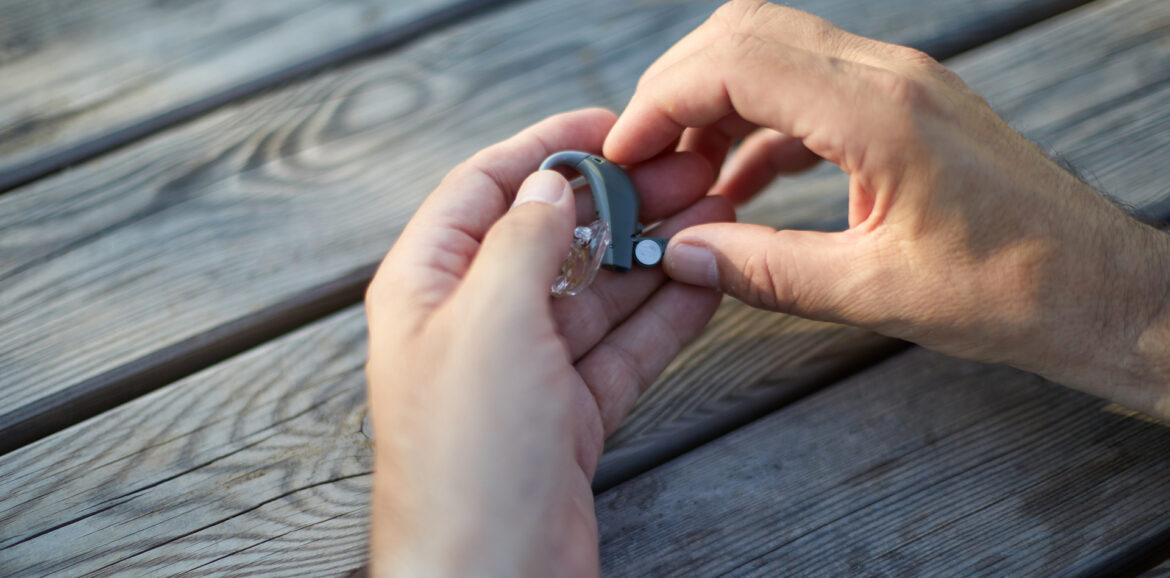
Hearing aid batteries: they are small, light, do their job nicely … until they suddenly decide to quit at exactly the wrong time. During a meeting. In the supermarket. Or – the classic – when someone finally says something interesting. But how long does such a battery actually last? And why does one sometimes seem to last indefinitely while the other drains faster than your phone at -5 degrees?
In this blog, we dive into everything that affects hearing aid battery life. Not dry theory, but clear and practical, so you know exactly what to expect AND how to get more out of them.
What determines the lifespan of a hearing aid battery?
The official, safe, “less exciting but correct” answer is: it depends. But fortunately, hearing aid batteries do not depend on randomness. There are obvious factors that come into play.
Size of the battery
The smaller the battery, the less capacity. It’s like comparing an espresso cup to a thermos. Both contain coffee, but one is empty within a minute.
The most commonly used zinc-air batteries are:
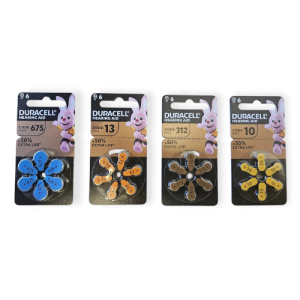
– P10 (yellow): small, compact, lasts an average of 3-7 days
– P312 (brown): an intermediate size, often lasting 5-10 days
– P13 (orange): larger, averaging 7-14 days
– P675 (blue): large and powerful, lasting up to 2-3 weeks
The numbers vary by user, but the principle remains: the bigger the battery, the longer it lasts.
Type of hearing aid
Not every hearing aid works equally economically. BTEs, RICs, CICs – they may serve the same purpose, but under the hood there is quite a difference.
– A discreet CIC hearing aid requires a lot from a small battery.
– A powerful BTE device for severe hearing loss sips more energy due to the amplification required.
It’s similar to cars: an electric bike really doesn’t have tank emptying like a truck.
Your listening behavior (yes, really)
The hearing aid never really stands still. But some situations drain your battery faster than others.
– Busy spaces, such as birthdays or Christmas parties, require more computing power.
– Listening to music or watching TV creates more complex sound processing.
– Lots of streaming (via Bluetooth, for example) is the biggest battery eater of all.
In short, the more sounds your hearing aid has to dissect, the faster your battery will run out.
Environmental conditions
Zinc-air batteries literally breathe air. And air can have quirks.
– Cold slows chemical reactions → battery seems to run down faster.
– Heat makes battery work harder → battery runs out faster.
– Humidity can affect air throughput.
That’s why batteries often do remarkably well in moderate room temperatures. And remarkably poor when standing outside waiting for the bus in February.
Age of battery
Even unopened zinc-air batteries slowly deteriorate. It’s not a tragedy – they have a decent shelf life – but a pack that has been sitting in a drawer for years may have a little less power than fresher ones.
Average life by battery type
Just a few more things in a row – because yes, we love overview:
– P10 (yellow): 3-7 days
– P312 (brown): 5-10 days
– P13 (orange): 7-14 days
– P675 (blue): 10 days to 3 weeks
These averages are not theoretical, but based on what most users experience. Are you structurally much lower? Then there may be other things going on – we’ll get to that in a moment.
Why does my battery sometimes suddenly last much shorter?
Does your hearing aid battery sometimes seem more like a fickle roommate who never keeps appointments? If so, this could be the cause.
You use new features
New hearing aids have countless smart features: noise reduction, directional microphones, AI environmental adaptation, Bluetooth streaming… All great – but they do cost energy.
You’ve been streaming a lot
Streaming music, TV or phone calls is the number one battery consumer. A day’s worth of streaming can shorten your battery life by as much as 30-50%.
Your environments change quickly
In a day, going from silence to noise, from outside to inside, from car to supermarket: the hearing aid must constantly adapt. And that takes computing power (read: energy).
Your batteries are old
Even unopened, they slowly lose energy. A pack that has been sitting for three or four years may simply perform less.
How do you get more out of your hearing aid batteries?
With a few simple habits, you can often extend your lifespan by days.
Let the battery “breathe” after removing the sticker
Zinc-air batteries do not become active until you remove the sticker. Then allow the battery to rest for 1 minute before inserting it into the hearing aid. That small moment allows it to fully recharge with oxygen.
Turn off your hearing aid when not wearing it
Not using for a while? Lid open, device off. Yes, that really makes a difference.
Store batteries at room temperature
Not in the car. Not next to the heater. Not in the refrigerator (yes, some people do that). Just in a drawer.
Use a drying box for your hearing aids
Moisture is the secret enemy of both hearing aids and batteries. A drying box not only extends the life of your devices, but also prevents energy loss due to condensation.
Always buy fresh batteries (from us!)
Batteries have an expiration date. Therefore, always buy your batteries from a reliable party with lots of circulation. We always have a fresh set for you, and quantity discounts apply to them as well!
Showing 1–10 of 55 resultsSorted by latest
- Toevoegen
- Select options This product has multiple variants. The options may be chosen on the product page
- Toevoegen
- Toevoegen
- Select options This product has multiple variants. The options may be chosen on the product page
- Select options This product has multiple variants. The options may be chosen on the product page
- Toevoegen
- Toevoegen
- Toevoegen
- Toevoegen





What if my batteries run out too fast structurally?
Then a few things may come into play:
– Your hearing aid has to work too hard – possibly because the setting needs to be adjusted.
– There is condensation in your device.
– The battery door does not close properly.
– The batteries are old.
– Your device is damaged.
In that case, it’s smart to stop by your audiologist. A quick check prevents you from muddling through for weeks with batteries that fail after only one day.
Choose a battery that suits your use
How long a hearing aid battery lasts depends on a mix of factors: the type of battery, your device, your listening situations and even the weather. But with the right knowledge and a little smart use, you can always get more out of them.
Whether you have a mild hearing loss or need a powerful amplifier, there’s always a battery that fits your lifestyle. And as long as you know why one sometimes drains faster than the other, you’ll never be surprised at the moment suprême – like when someone next to you whispers, “Hey … your battery is dead.”